
Heated blankets
How much does it cost to run a heated blanket?
Electric blankets are among the cheapest heating appliances in the house to run, but almost nobody quotes the actual arithmetic. Here is the formula, a worked example, and how to get the exact figure for your own blanket and your own tariff rather than a marketing estimate.
Written by the Coza team · Last reviewed
Quick answer
The cost of running a heated blanket is its wattage divided by 1,000, multiplied by the hours used, multiplied by your electricity price per kWh. A 100 W blanket run for 8 hours uses 0.8 kWh.
At an electricity price of €0.25 per kWh, that same 8-hour night costs about €0.20 — and the true figure is lower, because the thermostat cycles the element off once the blanket is up to temperature rather than drawing full power all night.
A 2,000 W electric space heater run for the same 8 hours uses 16 kWh, or about €4.00 at the same price — roughly twenty times more, because it heats the whole room instead of the bed.
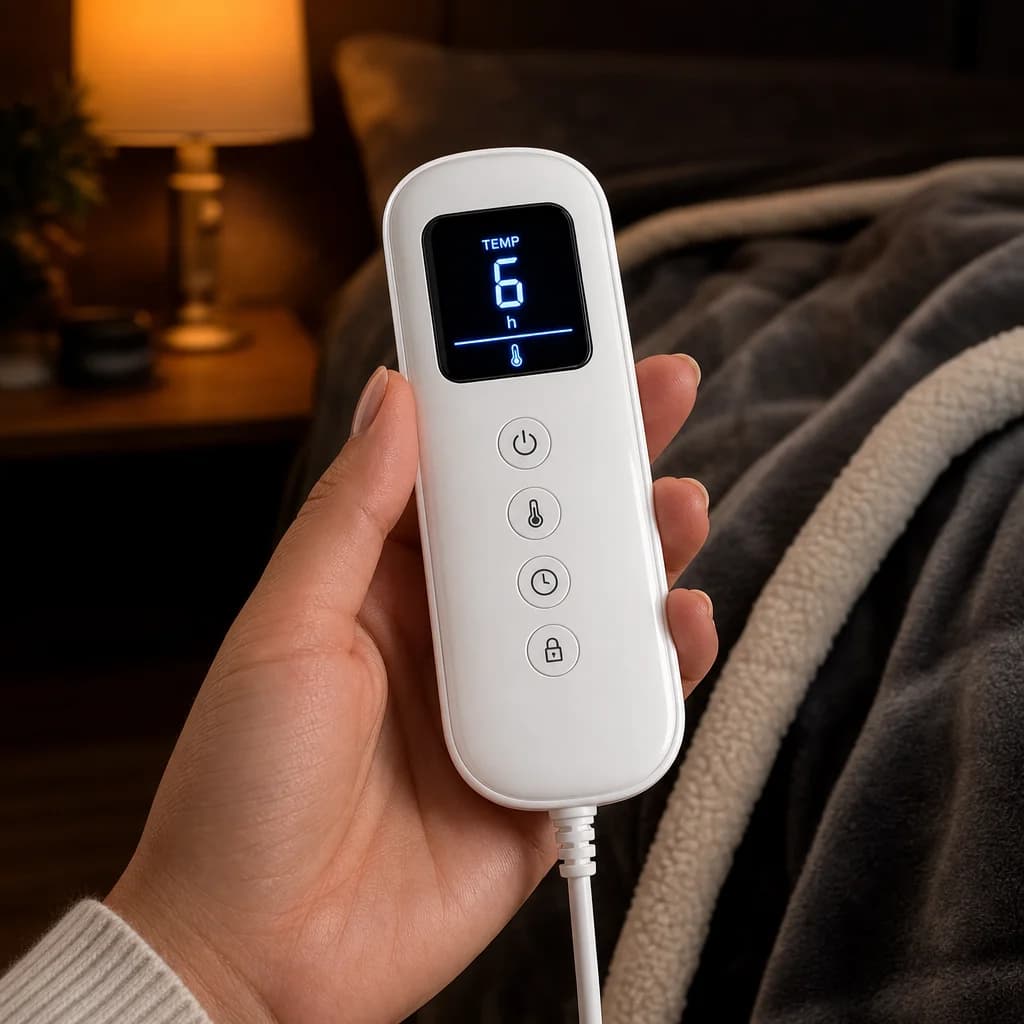
The formula
There is only one calculation, and it works for any electrical appliance:
Cost = (Watts ÷ 1,000) × hours used × price per kWh
You need two numbers to use it. The wattage is printed on the blanket label or the controller — it is the only reliable source, because it varies by size and model. Your price per kWh is on your electricity bill, usually shown as a unit rate.
Heated blankets are rated in watts, and most household electric blankets and throws sit somewhere in the tens-to-low-hundreds of watts, well below a kettle or a space heater. Always use the figure on your own label rather than a category average.
Worked examples at €0.25 per kWh
These use an illustrative 100 W blanket and an illustrative €0.25/kWh unit rate so you can see the shape of the numbers. Substitute your own two figures for an exact answer.
| Usage | Energy used | Cost at €0.25/kWh |
|---|---|---|
| 1 hour | 0.10 kWh | €0.03 |
| 4 hours (an evening) | 0.40 kWh | €0.10 |
| 8 hours (a full night) | 0.80 kWh | €0.20 |
| 8 hours a night, 30 nights | 24 kWh | €6.00 |
| A 2,000 W space heater, 8 hours | 16 kWh | €4.00 |
Why the real cost is lower than the calculation
The formula above assumes the blanket draws its full rated wattage every second it is switched on. It does not.
A thermostatically controlled blanket draws full power while it is heating up, then cycles the element on and off to hold the target temperature. Once the fabric and the duvet above it are up to temperature, the element spends most of its time off. On a low setting under a duvet, the average draw over a night is a fraction of the rated figure.
This is also why running level three all night is cheaper than running level nine for an hour and then level three: the blanket is not fighting a cold start.
How to cut the running cost further
Four changes, roughly in order of impact.
- Use the timer. A one to twelve hour auto shut-off means you are not paying for heat between 4am and 8am when you are asleep and the bed is already warm.
- Pre-warm high, then drop low. Fifteen to twenty minutes on a high setting, then level three or four for the night.
- Put a duvet over the blanket. Trapped heat means the thermostat cycles the element off more often.
- Cover only what you need. A 100 × 150 cm throw draws less than a 180 × 200 cm king, because there is less element in it.
Heated blanket vs space heater vs central heating
The comparison that matters is not appliance against appliance — it is what each one is heating.
Central heating warms the whole building envelope and continuously replaces the heat that escapes through walls, glass and gaps. A space heater does the same for one room. A heated blanket warms a thin layer of air held inside the fabric, directly against your skin, with a duvet on top holding it there. That is a target measured in litres rather than cubic metres, which is why the arithmetic is not close.
The trade-off is honest: a heated blanket only warms the person under it. It does nothing for the rest of the room, and it is not a substitute for heating a home to a safe temperature.
Frequently asked questions
How much electricity does a heated blanket use per night?
Take the wattage on the label, divide by 1,000, and multiply by the hours you run it. A 100 W blanket run for 8 hours uses 0.8 kWh, which is about €0.20 at €0.25 per kWh. Real consumption is lower because the thermostat cycles the element off once the bed is warm.
Is a heated blanket cheaper than a space heater?
Substantially. A 2,000 W space heater uses roughly twenty times the energy of a 100 W blanket over the same period, because it is heating the whole room rather than the bed.
Where do I find my heated blanket wattage?
On the care label sewn into the blanket or printed on the controller housing. Use that number rather than a category average, because wattage rises with blanket size.
Does leaving a heated blanket on low all night cost much?
Very little. On a low setting under a duvet the element spends most of the night cycled off, so the average draw is a fraction of the rated wattage. Using the built-in timer removes the hours you do not need entirely.
Read next
Is it safe to sleep with a heated blanket on all night?
Is it safe to sleep with a heated blanket on? What auto shut-off, overheat protection and CE and ETL certification actually mean, plus who should not use one.
Read the guideBest heated blanket for a cold bedroom
The best heated blanket for a cold bedroom: what to look for in heat levels, timers and fabric, and why heating the bed beats heating the room.
Read the guidePart of our complete guide to heated blankets
This page covers one question in depth. For sizes, fabrics, safety, running cost and washing in one place, start with the main guide.
Heated blankets: how to choose one, and how to use it wellThe Coza heated blanket
Nine heat levels, five-second warm-up, machine washable.
Brushed flannel over a sherpa reverse, a carbon element you never feel, and a shut-off you set from one to twelve hours. Four sizes from 100 × 150 cm to 180 × 200 cm, starting at €35.99.