
Heated blankets
How to wash a heated blanket safely
A heated blanket you use nightly has to be washed, and the fear of ruining it stops most people from doing it. The whole risk sits in two places: water reaching the controller, and heat reaching the internal wiring. Handle those two and the rest is an ordinary gentle wash.
Written by the Coza team · Last reviewed
Quick answer
Unclip the controller and the power cord first — always, without exception. Then machine wash the blanket alone at 30 °C on a gentle or delicate cycle with a mild detergent, and no more than a short low-speed spin.
Air dry it flat, never in a tumble dryer on heat and never on a radiator. Both concentrate heat on the internal wiring and can damage the element permanently.
Make sure the blanket is completely dry, then reconnect the controller. Never plug in or switch on a heated blanket that is even slightly damp.
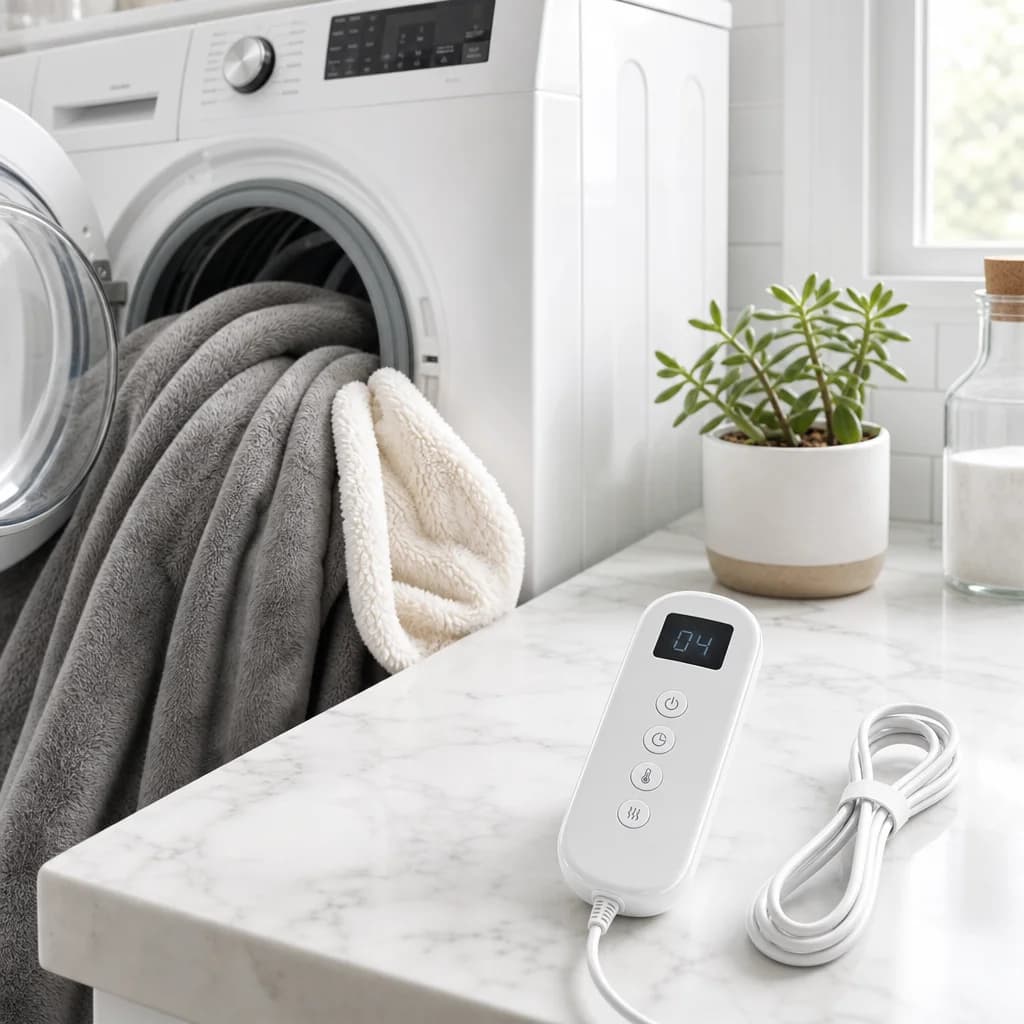
Before you wash: the two rules
Everything else in this guide is detail. These two are not optional.
- The controller and power cord must be fully detached. They contain electronics and are not waterproof. On the Coza blanket the connector unclips in one movement.
- No heat drying, ever. No tumble dryer on a heat setting, no radiator, no hairdryer, no direct sun for hours. Heat is what damages the element, not water.
Step by step: machine washing a heated blanket
Seven steps, start to finish. Allow a full day for drying.
- Switch it off at the wall and unplug it. Let it cool completely if it has just been in use.
- Unclip the controller and the cord, and set them somewhere dry and away from the machine.
- Check the blanket over for damage — scorch marks, frayed edges, a crushed connector. If you find any, do not wash it; retire it.
- Put the blanket in the machine on its own. No towels, no jeans, nothing with a zip or a hook.
- Wash at 30 °C on a gentle or delicate cycle with a mild liquid detergent. No bleach, no fabric softener — softener coats the fibres and flattens the pile.
- Use a short, low-speed spin. A long high-speed spin puts mechanical stress on the internal wiring.
- Air dry flat, spread out over a drying rack or a clean flat surface, turning it once. Never hang it by one edge — the weight of the wet fabric pulls on the element.
Sherpa-faced blankets hold more water than flannel and take longer to dry. Start the wash in the morning.
Hand washing, and spot cleaning
If you would rather not machine wash it, fill a bath with lukewarm water and a small amount of mild detergent, submerge the blanket, and press it gently — do not wring, twist or scrub. Rinse in clean lukewarm water, press the water out flat rather than wringing, and dry flat as above.
For a single spill, spot cleaning is better than a full wash. Blot with a damp cloth and a little mild detergent, working from the outside of the mark inward, then blot dry and let the area air dry completely before use.
How often should you wash it?
Every two to three months for a blanket used most nights, or immediately after a spill. Less often is fine for occasional sofa use.
Washing less often is genuinely better for the element than washing more often, so use a top sheet or a duvet cover between you and the blanket where possible and wash that instead.
What to do before switching it back on
Three checks, and they take under a minute.
- Confirm the blanket is completely dry — including the corners and the seam channels, which dry last.
- Check the controller socket is dry and clean before reconnecting.
- Reconnect, run it on a low setting for ten minutes, and feel across the whole surface for even warmth. Any cold patch, hot spot or burning smell means stop using it.
Never use a heated blanket to dry itself. Running the element to speed up drying is the single fastest way to destroy one.
Storing a heated blanket between seasons
Store it rolled, not sharply folded — repeated hard folds along the same crease fatigue the wiring at that line. Keep it somewhere dry, at room temperature, with nothing heavy stacked on top of it, and with the controller stored alongside rather than wrapped tightly around the blanket.
Frequently asked questions
Can you put a heated blanket in the washing machine?
Yes, provided the controller and cord are fully detached first. Wash it alone at 30 °C on a gentle cycle with a mild detergent and a short low-speed spin, then air dry flat.
Can you tumble dry a heated blanket?
No. Tumble dryer heat is concentrated and can damage the internal wiring permanently. Air dry flat, turning once, and allow a full day.
What temperature should you wash a heated blanket at?
30 °C on a gentle or delicate cycle. Hotter water risks the element and the fabric finish.
How long does a heated blanket take to dry?
Typically most of a day laid flat. A sherpa face holds more water than flannel and takes longer. It must be completely dry before you reconnect the controller.
Can you dry clean a heated blanket?
No. Dry cleaning solvents attack the insulation on the internal wiring. Machine wash cold or hand wash only.
Read next
Sherpa vs flannel heated blankets: which is warmer?
Sherpa vs flannel heated blankets compared on warmth, weight, washing and feel — and why a double-sided blanket removes the choice entirely.
Read the guideIs it safe to sleep with a heated blanket on all night?
Is it safe to sleep with a heated blanket on? What auto shut-off, overheat protection and CE and ETL certification actually mean, plus who should not use one.
Read the guidePart of our complete guide to heated blankets
This page covers one question in depth. For sizes, fabrics, safety, running cost and washing in one place, start with the main guide.
Heated blankets: how to choose one, and how to use it wellThe Coza heated blanket
Nine heat levels, five-second warm-up, machine washable.
Brushed flannel over a sherpa reverse, a carbon element you never feel, and a shut-off you set from one to twelve hours. Four sizes from 100 × 150 cm to 180 × 200 cm, starting at €35.99.